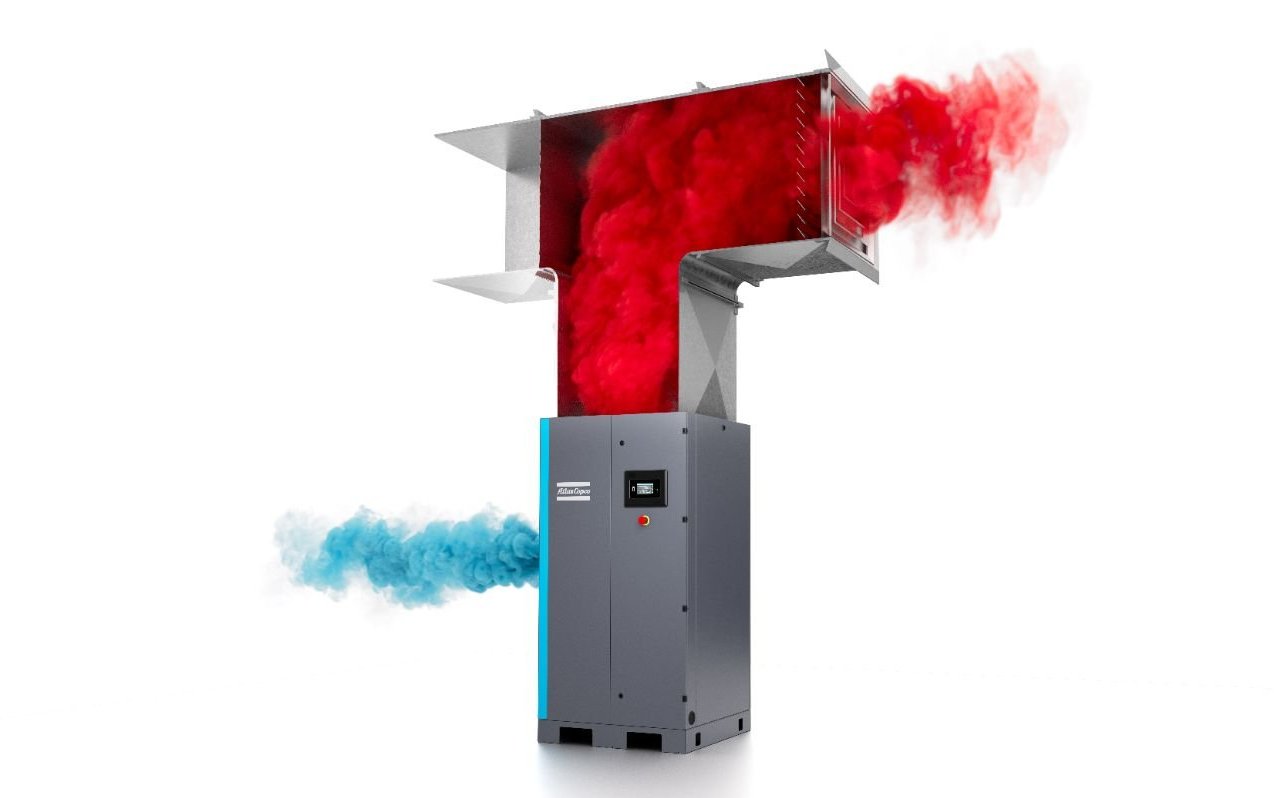
What is compressor waste heat recovery?
Compressing air generates a lot of heat. In fact, most of the electrical energy that a compressor consumes is converted into heat. Without energy recovery, this heat gets dissipated back into the environment – and simply vanishes into thin air. Hence the term “waste heat.”
An energy recovery system relies on a heat exchanger to capture most of this waste heat as hot air (with ducting connected to the compressor) or as hot water (with a water supply connected to the compressor) and re-use it somewhere else. Both hot air and hot water systems allow you to recover up to 94% of the heat of compression depending on the technology used.Contact an expert
Compressed air is an incredibly important utility. For many businesses, the compressor is their single most crucial piece of equipment. Unfortunately, compressing air inherently requires a lot of energy. In fact, over the lifetime of a compressor, energy by far constitutes the biggest cost, making up about 80% of its total cost of ownership. That is why using a highly efficient model is key. Next to choosing the right compressor, energy recovery is the technology that will have the biggest impact on your operational energy use. Recovering up to 94% of a lot of energy is, well, a lot of energy saved. This will have an immediate impact on your energy use and costs and on your facility’s carbon emissions. That means that if you are looking to lower your operational costs and/or meet a stricter emissions standard, energy recovery can help you get there. And with a typical return on investment of less than a year for Atlas Copco solutions, these benefits quickly add up.
In industrial compressed air systems, up to 90% of the electrical energy consumed by a compressor is converted into heat. Without energy recovery, this heat is dissipated through the cooling system and lost, resulting in avoidable energy losses and higher operating costs.
Energy recovery systems capture this waste heat and reuse it for productive applications, improving overall system efficiency and reducing the need for additional heating energy.
y reusing recovered heat, companies can reduce heating energy demand by 20–50%, depending on operating conditions and utilization. In many cases, payback periods range from 1 to 3 years, influenced by compressor runtime, energy prices, and application fit.
When heat demand does not coincide with compressor operation, thermal energy storage (TES) can be integrated. This allows excess heat to be stored and reused later, increasing the share of usable recovered energy and improving overall recovery efficiency to approximately 60–90%, depending on the application.
👉 Once recovered, this energy can be reused across a wide range of industrial applications.